
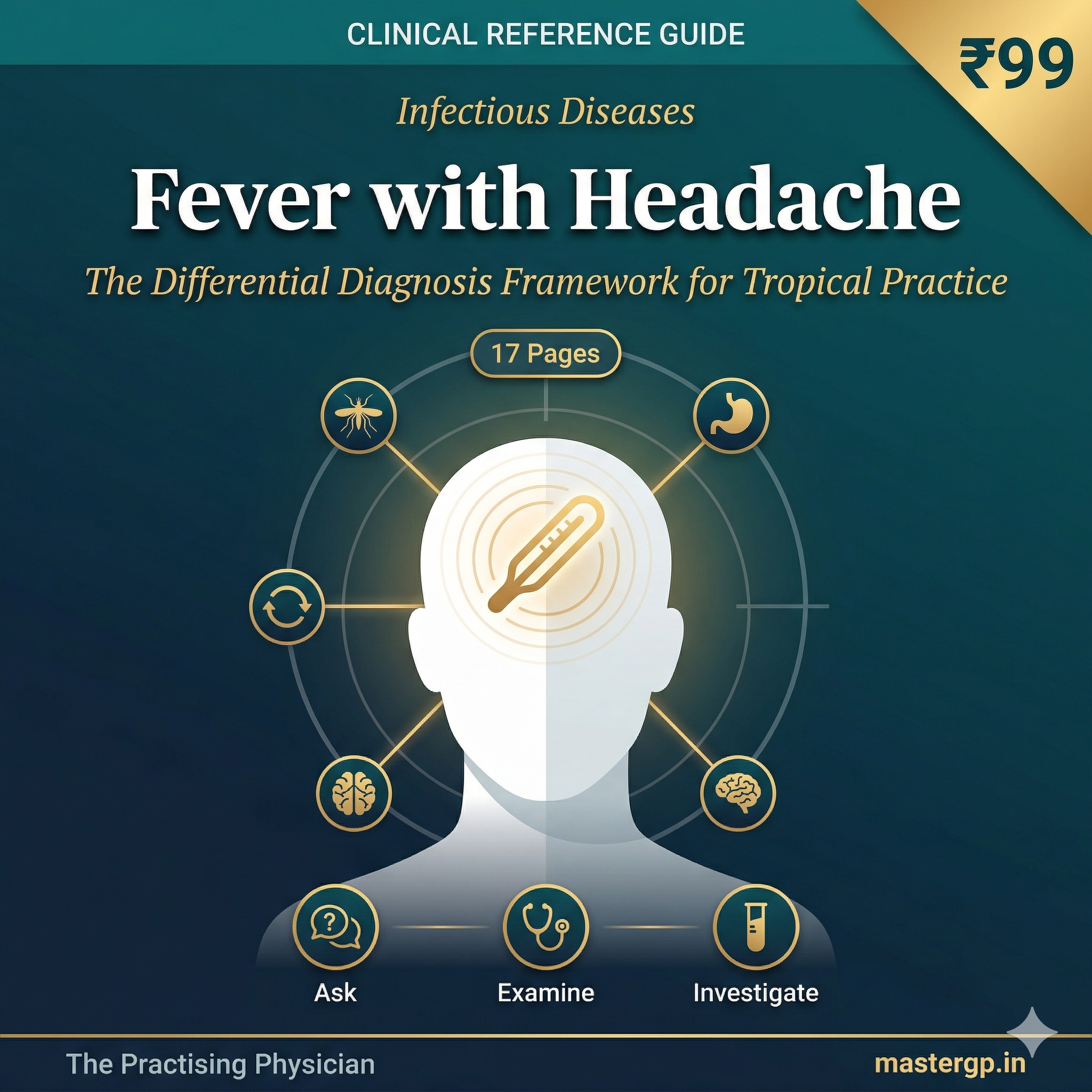
Fever with Headache — The Differential Diagnosis Framework for Tropical Practice
A 30-year-old man presents with high fever and headache for 5 days. Is it dengue? Malaria? Typhoid? Meningitis? This guide teaches you how to find the answer at the bedside.
Why This Guide Exists
Fever with headache. You see this presentation ten times a week. And ten times a week, you face the same quiet uncertainty — is this viral? Is this dengue? Could this be meningitis? Should I send this patient home or send them to a hospital?
Most GPs prescribe paracetamol, order a CBC, and wait. That approach works when the diagnosis is benign. But when the diagnosis is bacterial meningitis, or dengue haemorrhagic fever, or cerebral malaria — waiting is the mistake that changes the outcome permanently.
This 17-page clinical framework gives you the structured thinking process that separates the dangerous from the benign at the bedside — before the lab reports arrive. Calibrated for West Bengal and tropical India — the infections that actually walk into your OPD, not the ones that fill Western textbooks.
What You Will Learn
The Differential Diagnosis Map
The four categories of fever with headache — vector-borne infections, enteric infections, CNS infections, and systemic infections — and how to determine which system the fever is arising from using targeted history alone.
The Pivot Questions
The specific questions that narrow the differential efficiently. What does the fever pattern tell you? What does the headache character reveal? Which associated symptoms point to which diagnosis?
The Fever Pattern Framework
How to distinguish continuous fever (typhoid), intermittent fever with rigors (malaria), saddleback fever (dengue), and stepladder fever. Each pattern points to a different diagnosis.
The Headache Red Flags
The features that separate a benign viral headache from meningitis, encephalitis, and cerebral malaria. When neck stiffness, photophobia, altered sensorium, and seizures change the urgency completely.
The Rumple-Leede Tourniquet Test
Step-by-step instructions for the bedside test that screens for dengue haemorrhagic fever. How to perform it, how to interpret it, and when a positive result demands immediate action.
Systematic Examination Framework
Focused and purpose-driven. What to look for on general examination, what the skin tells you (petechiae, eschar, rash), what the abdomen reveals, and the neurological examination that rules out CNS involvement.
The Investigation Protocol
What to order for every patient (CBC, peripheral smear, dengue NS1/IgM, Widal, blood culture, LFT, RFT), and when to escalate to CSF analysis, malaria rapid antigen, scrub typhus IgM, and neuroimaging.
The Tiered Differential Diagnosis
Ranked by probability for tropical India — from most common (dengue, malaria, typhoid) to important to consider (scrub typhus, leptospirosis) to must-not-miss emergencies (bacterial meningitis, cerebral malaria, dengue shock syndrome).
Who Is This For
MBBS students doing their medicine rotation who need a systematic approach to tropical febrile illness.
Interns managing fever cases in casualty and medicine wards who can’t afford diagnostic uncertainty.
Junior doctors in general practice who want to diagnose with confidence before the lab report arrives.
Experienced GPs who want a structured, geography-aware framework for the most common OPD presentation.
Ready to Master Tropical Fever Diagnosis?
Create a free account or log in to purchase this guide. The next patient with fever and headache will meet a GP who knows which system is burning.